
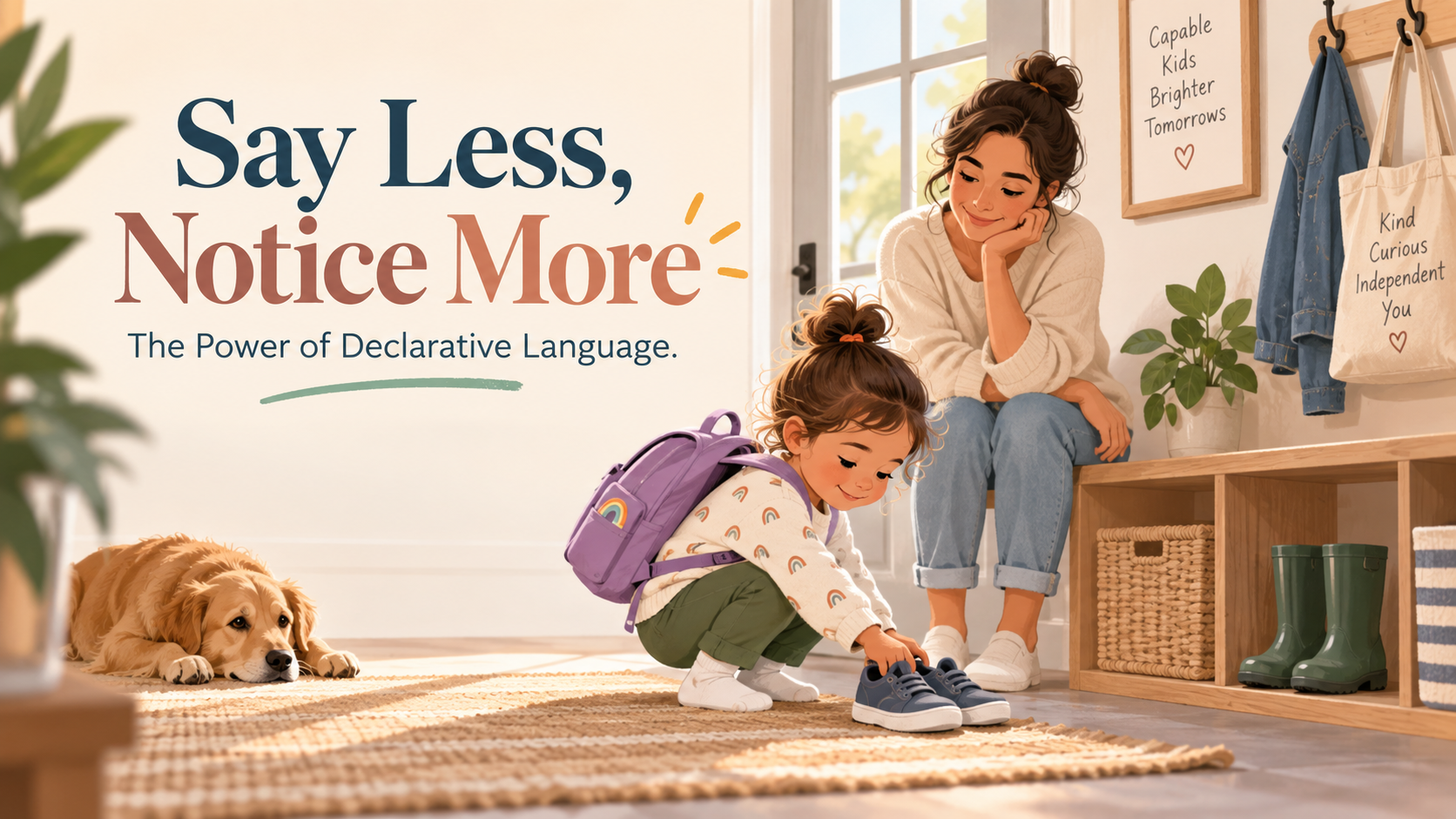
If you spend time with kids, you probably say things like this all day long:
“Put your shoes on.”
“Come sit at the table.”
“Clean up your toys.”
“Tell her what you want.”
And honestly, sometimes that is exactly what is needed. Kids need clear directions. Safety matters. Routines matter.
But sometimes, we can say a little less and give kids a little more room to notice, think, and figure things out.
That is where declarative language comes in. ✨
🌱 So, What Is Declarative Language?
Declarative language is simply language that shares information, observations, thoughts, or feelings instead of immediately telling someone what to do.
For example:
Instead of:
“Get your shoes.”
Try:
“Hmm… everyone else has their shoes on.”
Or:
Instead of:
“Put your cup in the sink.”
Try:
“I see an empty cup still hanging out on the table.”
Or:
Instead of:
“Give him a turn.”
Try:
“He keeps looking at that toy. I wonder if he wants to play too.”
The idea is not to be mysterious or make children guess what adults want.
It is to create a little bit of space.
A tiny pause.
A chance for the child to notice what is happening and think:
What could I do next?

💭 Why Does That Matter?
When adults solve every tiny problem for children, children do not always get many opportunities to practice solving those problems themselves.
Imagine there is water on the floor.
We could say:
“Go get a towel.”
Problem solved.
Or we could say:
“Uh-oh. We have a puddle.”
Now there is a moment of possibility.
Maybe the child grabs a towel.
Maybe they ask for help.
Maybe they stare at the puddle like it has personally betrayed them.
All of those responses give us useful information about what support they need.
🌼 It Can Build Independence
Children hear a lot of instructions throughout the day.
Put this away.
Come here.
Sit down.
Grab your backpack.
Wash your hands.
Find your coat.
After a while, some children can get very good at waiting for the next adult prompt.
Declarative language gives us another option.
Instead of:
“Put your backpack by the door.”
Try:
“We’re leaving soon, and your backpack is still on the couch.”
Then wait a few seconds.
That tiny pause gives the child an opportunity to connect the dots themselves.
And when they do?
That is their problem-solving at work.

🤝 It Can Reduce Everyday Parent-Child Friction
There is another benefit that can be easy to overlook: declarative language can sometimes make everyday interactions feel a little less like a constant stream of commands.
For many kids, hearing direction after direction can start to feel like someone else is always deciding what happens next.
“Put that away.”
“Come here.”
“Do this.”
“Stop that.”
Even when those directions are completely reasonable, the sheer number of them can create friction — especially for children who strongly value autonomy or are eager to do things “by myself.”
Declarative language can shift the feel of the interaction.
Instead of:
“Go put your shoes on.”
Try:
“We’re getting ready to leave.”
Now the child has a chance to notice what needs to happen and take part in the process.
That does not mean the child is suddenly in charge of every decision, and it does not mean parents need to avoid setting limits.
It simply creates more moments where children can experience a sense of agency within the boundaries adults have already set.
Sometimes that small shift — from being told to figuring it out — can make routines feel more collaborative and a little less like a tug-of-war.
And over time, those little opportunities can help children build confidence in their own ability to notice, decide, and act.
👀 It Can Help Kids Notice Other People
Declarative language can also help children tune into the people around them without requiring one exact social response.
Instead of:
“Say hi to Grandma.”
Try:
“Grandma’s here!”
Instead of:
“Ask him if you can play.”
Try:
“He’s building a really tall tower.”
Instead of:
“Give her a turn.”
Try:
“She’s watching the swing really closely.”
Now the child gets to notice the situation and decide how they want to respond.
Maybe they wave.
Maybe they walk over.
Maybe they offer the toy.
Maybe they do not respond at all yet.
That gives us a more natural opportunity to support social learning without scripting every interaction.
🎨 It Leaves Room for Creativity
One of the fun things about declarative language is that there is often more than one “right” answer.
Imagine you say:
“We have a lot of toys to carry upstairs.”
One child might grab a basket.
Another might make five tiny trips.
Another might recruit a sibling.
Another might try to carry twelve stuffed animals at once and immediately regret their choices.
That is flexible thinking.
If we had started with:
“Go get the basket.”
…we might have skipped over all of those possibilities.

✨ A Few Everyday Swaps
Instead of: “Put your coat on.”
Try: “It looks pretty chilly outside.”
Instead of: “Clean up your toys.”
Try: “There are still toys on the floor, and we’re getting ready to leave.”
Instead of: “Get your water bottle.”
Try: “I don’t see your water bottle with your things yet.”
Instead of: “Move your plate.”
Try: “We could use a little more room on the table.”
Instead of: “Let her have a turn.”
Try: “She’s been waiting and watching the swing.”
Instead of: “Go wash your hands.”
Try: “Dinner is almost ready.”
Instead of: “Get a towel.”
Try: “We’ve got some water on the floor.”
The goal is not to turn every sentence into a riddle.
It is simply to look for moments when a child might be able to notice something and take the next step with a little less adult direction.
🌿 What If They Don’t Do Anything?
This part is important:
Declarative language is not supposed to become a test.
If you say:
“There are toys on the floor, and we need to leave soon,”
and your child keeps playing like you have said absolutely nothing, that does not mean you need to repeat the same sentence six more times in increasingly dramatic tones.
You can add support.
Maybe:
“I wonder what we could do with the toys.”
Then:
“Maybe we could put them in the bin.”
And if needed:
“Let’s put the toys in the bin.”
The goal is not to make children struggle.
The goal is to give them a chance to think before we jump in with the answer.
🚦 Sometimes a Direction Is Exactly What You Need
Declarative language is one tool in the toolbox.
It is not a rule that every direction needs to disappear.
If a child is running toward a parking lot, “Stop!” is much more useful than:
“I notice there are cars nearby.”
Children may also need clear, direct instructions when something is new, confusing, overwhelming, or time-sensitive.
The sweet spot is being thoughtful about when we direct and when we can step back a little.
💛 Try It During One Routine
You do not have to change the way you talk overnight.
Pick one part of the day:
Getting ready for school.
Cleaning up.
Mealtime.
Bedtime.
Going to the park.
Notice how often you tell your child exactly what to do.
Then try replacing just one or two directions with an observation.
Say what you notice.
Pause.
Give them a chance.
You might hear yourself saying a little less.
And you might get to watch your child do a little more.
That is really what declarative language is about: creating small moments where children can notice, wonder, problem-solve, make choices, and participate in what happens next. 💛
A Little Less Telling, A Little More Trust 💛
Declarative language is not about finding the perfect words every time. It is about creating more little moments where children have space to notice, think, and participate — with a supportive adult nearby when they need help.
Sometimes, small changes in how we communicate can make everyday routines feel a little more connected, a little less stressful, and a lot more collaborative.
If you are looking for support helping your child build independence, communication, flexibility, or other everyday skills, Contact Us to learn more about how we work with children and families.